Strategy
Search and audience strategy that is native to Microsoft, not copied from Google
Copying a Google strategy into Microsoft Advertising gets you Google results with less volume. The platform has its own auction, its own audience signals and placements that have no equivalent anywhere else. This is how we structure search and audience campaigns when we build for Microsoft on purpose.
Structure that fits the Microsoft auction
Fewer competitors change the math. On Google, highly granular structures exist to control cost in a crowded auction. On Bing, over-segmentation starves ad groups of the data that automated bidding needs to work. We build fewer, broader ad groups organized by intent, separate brand from non-brand, and let responsive search ads do the matching work within each group.
Match types behave differently too. Phrase and broad match on Microsoft Advertising often return more varied queries than their Google equivalents, so the search term report matters more, not less. We run a Dynamic Search Ads campaign alongside keyword campaigns from the start, both to catch queries we did not predict and as a research tool for new keywords worth adding.
Search partners deserve a deliberate decision. Traffic from Yahoo, DuckDuckGo, AOL and syndicated partner sites can be excellent or poor depending on the category. Segment the performance report by network, and use website exclusions to remove partner sites that bring clicks without conversions, rather than switching partners off entirely and losing the good ones.
LinkedIn profile targeting, used properly
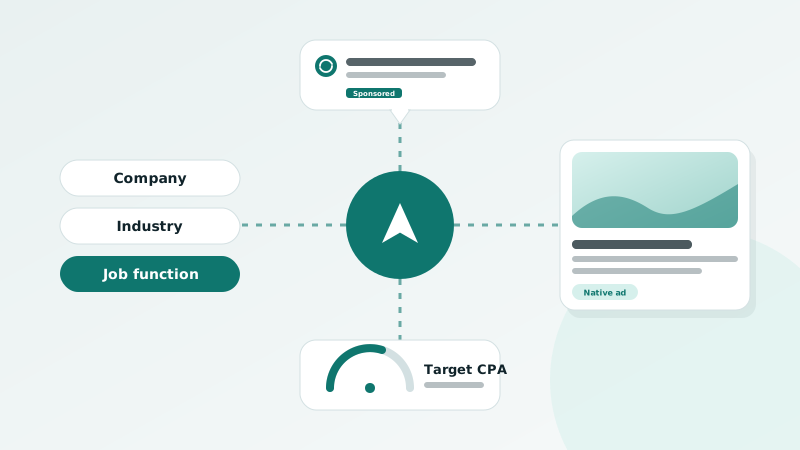
This is the feature most advertisers never configure. In search, Shopping and Audience Network campaigns, you can target or adjust bids by company, industry and job function using LinkedIn profile data. The matching is not complete, because not every searcher is matched to a profile, so start with bid adjustments rather than exclusive targeting. Observe which industries and functions convert, then raise bids on them and lower bids elsewhere.
Use cases go well beyond B2B. A continuing education provider might raise bids on healthcare job functions. A home services company with premium pricing might adjust bids by industry as a proxy for income. A SaaS product sold to finance teams can bid up on finance functions across every campaign, including generic keywords that would be too broad without the layer. The point is to add a signal Google cannot offer onto keywords you already run.
The Audience Network is native, not display
The Microsoft Audience Network places image-based and feed-based ads in native positions across MSN, Outlook.com, Microsoft Start, Edge and partner publishers. It rewards creative that reads like editorial: a clear headline, a relevant image, no banner cliches. Treat it as a separate campaign with its own budget and goals rather than a checkbox on a search campaign, so you can judge it on its own terms.
Audience order matters. Start with remarketing lists built from your UET tag, because people who already visited convert at the highest rate. Add in-market audiences next, where Microsoft identifies users showing purchase intent in a category. Similar audiences and combined lists come later, once you know what the first two produce. Review the placement report weekly and exclude websites that generate clicks and nothing else. Expect the Audience Network to assist conversions more than it closes them, and judge it with that in mind.
Copilot and Edge placements
Ads now appear within Copilot conversational experiences and across Edge surfaces. These placements serve through your existing campaigns according to your network settings, so the practical work is to make your ads answer questions. Copilot users write longer, more specific prompts. Headlines and descriptions that state plainly what you offer, for whom and in what kind of price range perform better than clever ones.
Segment reports by network and placement to see what these surfaces deliver, and expect the mix to change as Microsoft expands them. Do not opt out reflexively, and do not assume they behave like classic search either. Measure deliberately and let the data decide whether they earn more budget.
Bidding: let conversion volume decide
Bid strategy choice should follow data volume, not preference.
- At launch, with little conversion history, use manual CPC or enhanced CPC. Bing's lower competition means manual bids are genuinely manageable, and you learn what the auction costs.
- Once campaigns collect conversions steadily each week, move to target CPA. Set the target near your actual recent cost per conversion, not at your ideal, then tighten it over several weeks.
- With revenue tracked, target ROAS becomes available for e-commerce and for lead businesses that import deal values.
- Maximize conversions suits campaigns with a fixed budget that you want fully spent without a cost target.
Portfolio strategies across similar campaigns pool data and settle faster. Whatever you choose, change one thing at a time and give it two to three weeks before judging, because the learning period on a lower-volume platform is real.
Shopping and Performance Max for catalog businesses
For stores, the product feed in Microsoft Merchant Center is the campaign. Titles should lead with what people search for, attributes should be complete, and images should meet the specifications so products are not silently excluded. Standard Shopping campaigns give you control over product groups and bids. Performance Max for Microsoft Advertising adds automation across search, Shopping and the Audience Network using the feed plus your asset group.
Run both. Shopping gives you control over your best products and brand terms. Performance Max finds incremental volume you would not have bid on. Use brand exclusions where available so automation does not take credit for customers who were already yours, and check the new versus returning customer split before deciding which campaign deserves the next budget increase.
Key takeaways
- Fewer, broader ad groups organized by intent suit the Microsoft auction better than Google-style granularity.
- Run Dynamic Search Ads from day one as a research tool, and manage search partners with website exclusions rather than an on-off switch.
- Start LinkedIn profile targeting as bid adjustments, then concentrate spend on the industries and functions that convert.
- Treat the Audience Network as native, start with remarketing, add in-market audiences, prune placements weekly.
- Write ads that answer questions for Copilot surfaces, and measure them by network.
- Let conversion volume decide the bid strategy, and change one thing at a time.
If you would like this strategy applied to your account by a team that works only on Microsoft Advertising, send us a few details and we will reply within one business day.